Brownies, Blazers and Big Hearts: Tuesdays at the Community House
4th November 2025
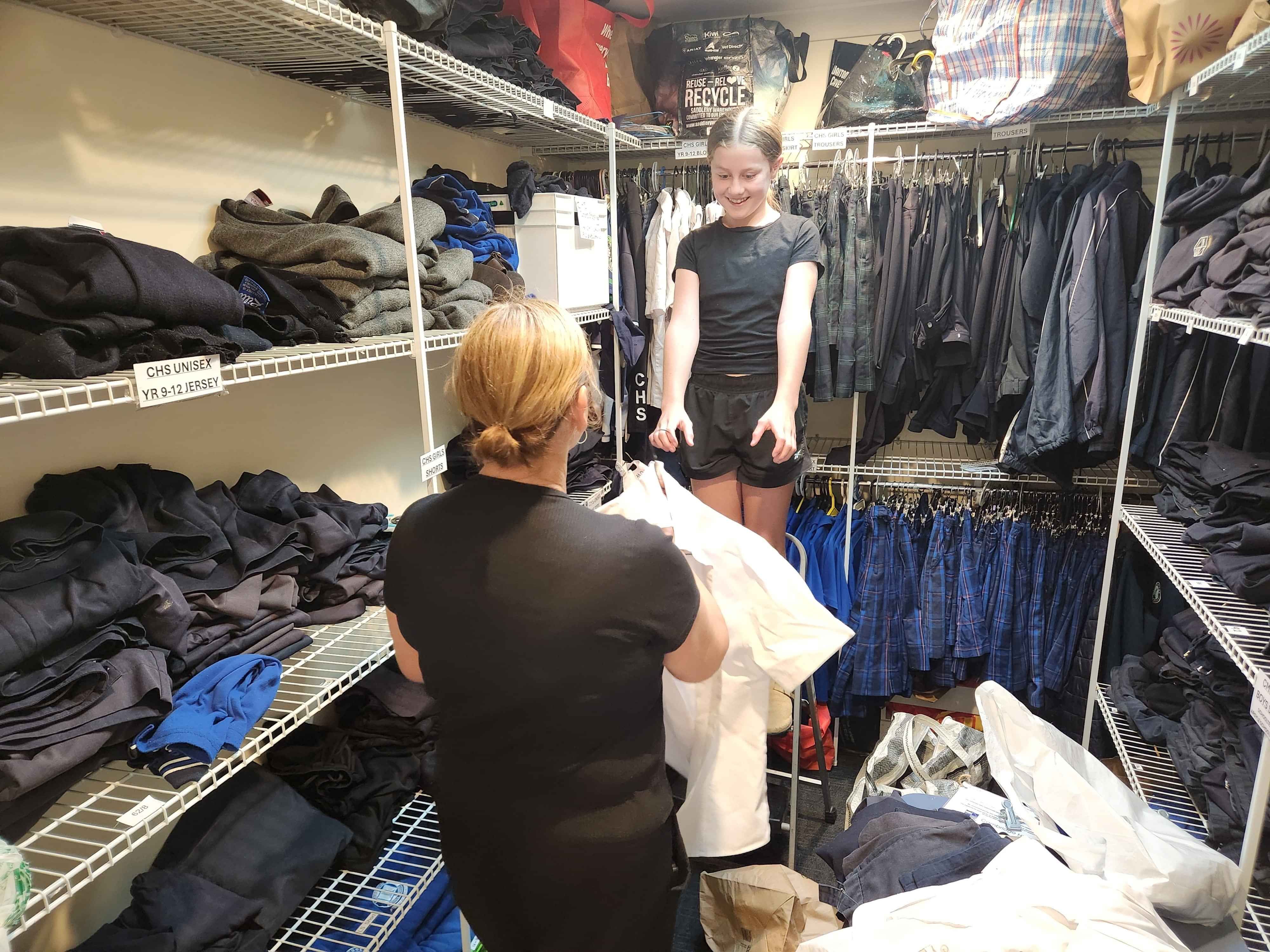
When Heather turned up to help with the Cambridge Community House uniform sale in January, she thought she was just lending a hand. Nine years working at the High School Uniform Shop had given her a sixth sense for sorting blazers from PE tops. But what started as a one-off favour quickly became a weekly ritual, with her granddaughter Makenzie in tow.
Makenzie, 11, is homeschooled. Her mum handles the maths and reading, while Heather (aka Nana) takes charge of baking, life skills, and community adventures. Tuesdays are their day together, and volunteering at the Community House has become part of the curriculum. “It’s like social studies,” Heather jokes, “but with chocolate brownies and lost socks.”
The uniform shop is no joke, though. With multiple schools, seasonal changes, and a new high school uniform rollout, it’s a jungle out there. Heather’s encyclopedic knowledge of school dress codes helps parents navigate the chaos. “It can be stressful,” she says. “Which shirt goes with which year, which gender, which term—it’s like decoding a secret language.” She’s brought order to the madness with clearer labels and tidier racks, so even when she’s not around, families can find what they need without needing a PhD in schoolwear.
But Heather’s learned a few things herself. “I had no idea how many services the Community House offers,” she says. “It’s not just counselling or financial mentoring. People come in for all sorts of reasons. It’s like the Swiss Army knife of community support.”
Heather’s connection to the community runs deep. She’s on the board of the local marae and often sends people to the House for help. Her own mum was cared for there years ago, and she’s always had a soft spot for the place. “It just gets the vibe of Cambridge,” she says.
For anyone thinking about volunteering, Heather has some sage advice: “Just try it. People think it’s a big commitment, but I only come for an hour a week. I could come more, but then I’d miss my baking sessions with Makenzie.” Speaking of baking, Makenzie’s favourite part of volunteering is the sweet treats in reception, generously donated by Good Bitches Baking. “Especially when there’s chocolate brownie,” she says with the seriousness of a food critic.
Asked to describe Cambridge Community House as a person, Heather laughs. “Maybe someone with multiple personality disorder but in a good way. Welcoming, supportive, always happy to see you.” Makenzie agrees. “It feels good to go there. It’s never a chore.”
Together, Heather and Makenzie show that volunteering isn’t just about giving back, it’s about learning, laughing, and maybe sneaking a brownie or two along the way.
Reflecting on Our Shared Needs
3rd November 2025
by Dianne Carter - Counsellor
Over the past year, I have noticed more people feeling uncertain about life. Many speak about financial pressures, about systems they once trusted that now seem stretched or unresponsive, and about how hard it can be to find steady ground when things keep changing. I hear the same messages in the news and from neighbours and friends.
When the world feels unpredictable, it reminds me how important the basics are. Having a safe home, enough to eat, and people who care about us are the foundations that keep us steady. Without them, everything else becomes harder. Maslow’s Hierarchy of Needs shows this clearly. Unless we have those first layers of safety and belonging, it is very difficult to focus on growth, confidence, or connection.
As a counsellor, I see what happens when those foundations are shaken. A young mother might come in after losing her job, feeling she has failed her children. An older man might be grieving his partner and feeling invisible in a world that moves too fast. In both cases, it is often not quick answers that help, but listening, kindness, and small steps toward rebuilding trust in themselves and others.
Our systems often struggle to respond to this deeper kind of need. Many of them were built by people who already had stability, rather than by those who understand what it is to live without it. When only a few voices are heard, the system cannot hold everyone. True resilience grows when we include all perspectives, listen with intention, and remember that every person has value that cannot be measured in money.
Sometimes, it feels as if our society has become more focused on the “I” rather than the “we”. We see more judgement and less empathy, more fear of scarcity and less belief in abundance. This way of thinking separates us from one another and increases anxiety and loneliness. Yet every act of care, no matter how small, can shift this pattern.
At the Community House, I am reminded daily that people are at their strongest when they feel seen and supported. Whether its a volunteer offering a warm smile, a whānau support worker helping a family find a home, a counsellor listening without judgement, or a financial mentor guiding someone through debt, all create ripples of connection. These moments build hope.
Perhaps these times of uncertainty are also an invitation to rebuild. Humans are not designed to be alone. Caring for ourselves, for each other, and for what nourishes our whole wellbeing remains at the heart of who we are and the work we do together.
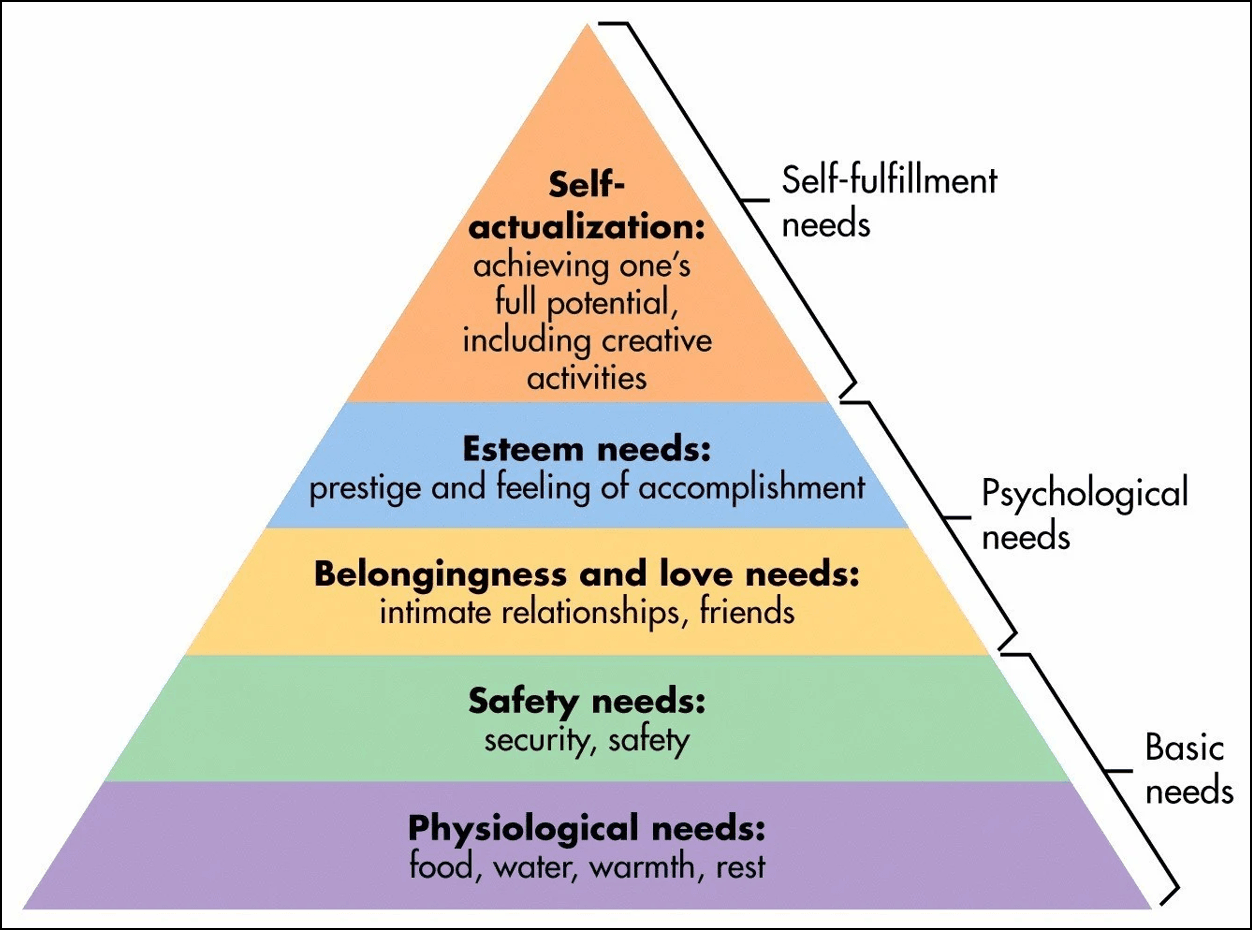
Maslow's Hierarchy of Needs | Image from Simply Psychology
On the road to a Violence-Free Waipā
20th October 2025
by Anne Morrison
The Loves-Me-Not programme continues to be offered throughout our secondary schools in Waipā and some of our Waitomo neighbours. As this programme is a very full day for students with some heavy content, we have negotiated with schools to delay the topic 5 area of ‘a call to action’ and have schools work with students 1-2 weeks after the main session. This gives students who are more reflective, some space and time to think about what they might do moving forward. We are also working with Police to include some more content on AI and how this impacts a young person’s life in terms of relationships. This will be used in the programme with St Peters College year 11 students in November.
Following the completion of the I AM ME pilot programme in Cambridge, a full and comprehensive evaluation took place. Many changes were made to the content and delivery to create a better version of itself. The programme is now being rolled out in the Te Awamutu, Kihikihi and Pirongia communities. The initial community forum was held to raise the awareness of the issue of family violence, share local statistics, present the evaluation from the pilot and bring the community together to see how we can work collectively in this programme. Violence Free Waipa is also lucky to be working with a wonderful volunteer, Alison Powell, who has a background in project management, community engagement, facilitation and working within family violence agencies. Liaison with guest facilitators and the pre-programme interview with potential participants will continue up until Christmas, with the programme starting in February 2026.
Sobering Statistics
While researching family violence information to share with our Te Awamutu, Kihikihi and Pirongia communities, I was blown away by the rates of reported cases of family harm. In 2023 there were 677 reported cases and in 2024 this rose to 745. Year to date numbers in 2025 look to be at a similar rate, equating to more than two cases per day. Remember though, that these are reported cases only. The New Zealand Crime and Victims Survey released in 2024, suggests that only 24% of interpersonal violence is actually reported to Police.
New Zealand’s rates of domestic and family violence are among the highest in the OECD. Maori women are particularly at risk – more likely to be killed by a partner and less likely to seek help. To quote Emma Powell, a key member of the national Executive Board for the Elimination of Family Violence and Sexual Violence, she believes that “the only way forward is doing things as collectives, and that’s tough, it is hard, hard stuff to do, but it’s really important.”
Hence, this is why I AM ME has been designed to be collaborative, to bring communities together in partnership to support the women that a victim-survivors of family violence in their communities.
Quotes from women in the pilot programme:
“Throughout the programme, the support and meeting other women gave me a sense of normality.”
“If I had known what I’ve learned in the last eight weeks, back then, maybe my life would have been different and my kids.”
“It makes you feel like you’re not alone, you’re not crazy.”
Fundraising and costs around the corner
Roof update: We did it! Thank you to everyone who contributed to our roof fundraising campaign. We’re pleased to share that we’ve reached our target of $5k and will be replacing the roof on our much-loved meeting room in the coming months. Your support means a great deal. We held a fundraising movie night in October with the “Roofman” movie and raised $570. We also had a GiveaLittle page that raised approximatley $3k. And there were other private donors that helped out - including a substantial contribution of $7,500 from the Waipā Mayoral Fund.
In a challenging funding environment, this success shows what’s possible when our community comes together. Thank you for standing with the Community House and supporting the work we do.
Reception area renovation: We need $13k to do a much needed revamp of the reception area where people wait for their appointments, the JP (on Wednesday’s), volunteer drivers reporting in, and sometimes parents just waiting for their children’s appointment to finish. It gets crowded at times, and our volunteers on reception are a whizz at coordinating and making sure people are seen to. This revamp of the immediate area will make a difference and allow our food rescue and organising of documents with a nice big cabinet. We have received $4k from the Page Trust and just need another $9k to start the work. Please consider donating here.
Revamp Clothing Swap: Thank you to everyone who came along, donated, swapped, and supported the recent Revamp Clothing Swap event! Over 70 tickets were sold, with three inspiring guest speakers, and more than 1,000 items of clothing swapped.Thanks to the incredible efforts of Maz and Renae, and the support of Waste Less Waipā, an amazing $2,137 was raised for the Community House. The funds will go directly to the Whānau Support Service, helping local wāhine in urgent need. The event was a vibrant celebration of sustainability, community, and empowerment.
Other Events Coming up:
Row-athon: Bigger, Better, and Back This Summer! We’re gearing up for our biggest Row-athon yet, and it’s shaping up to be a high-energy community challenge. We're currently in talks with three Cambridge gyms who may be joining forces or facing off in some friendly competition. Together, we’re aiming to hit a massive milestone: 1 million metres of rowing, biking, or skiing toward the finish line. Stay tuned for updates and get ready to move for a great cause!
Last year’s event raised over $6,000 for the Community House, and this year we’re aiming to more than quadruple that with the help of business sponsors, gym buddies, and community support. Expect energy drinks and rehiydration stations at each gym, spot prizes, music, kids’ zones, demonstrations on proper techniques, and a live stream of the action of each gym across Facebook so everyone can cheer us on.
It’s a great chance for people of all ages and fitness levels to get active, try out gym equipment like rowing ergs, cross-country ski machines, and bikes, and contribute to a great cause. Every metre counts!
Let’s get moving, connect with our community, and make a real difference together.
The Human Face of Policy: Whānau Support in Action
31 October 2025
At the Community House, the impact of government policy is not measured in spreadsheets or press releases. It is seen in the faces and stories of the people who walk through our doors. Behind every statistic about housing, welfare, or income support is a whānau trying to stay afloat.
One mother came to us after leaving a violent relationship. She had two young children and was living in her car. One of her children had a developmental disability, requiring regular specialist care that became almost impossible to maintain without a fixed address. The stress was affecting her health and her ability to parent. She was also burdened with debt from her previous relationship, including unpaid utility bills and fines. These followed her into her new life, damaging her credit rating and making landlords hesitant to rent to her. Even with budgeting support, the financial strain was relentless. At the same time, she was fighting a Family Court case to gain full custody of her children. The instability of her housing situation was being used against her, despite her commitment to providing a safe and loving home. Delays in legal aid only added to her anxiety. She felt punished for circumstances beyond her control.
If that sounds overwhelming, imagine living it. For this mother, every day was a struggle not just to survive, but to protect and care for her children within a system that too often seemed stacked against her.
As one Relationship Manager recently reflected, the challenges facing our communities are not about individual effort, but about systemic barriers that make it harder to do the work we all care deeply about. Across the district, frontline agencies are showing extraordinary commitment to whānau while working within systems that are stretched, inconsistent, and at times dangerously unresponsive.
This is where our Whānau Support Team steps in. We do not offer quick fixes. What we offer is resilience, practical guidance, and a steadfast commitment to walk alongside people through the hardest moments of their lives. We help untangle problems one at a time, connecting whānau with housing, health services, legal support, and financial mentoring. We advocate, we listen, and we stay the course. Sometimes, despite our best efforts, the outcome isn’t what we hoped for. But we remain ready, always, to provide support in whatever way the client needs.
The stories we see every day are shaped by policy. This is where the real effects of change are felt. It is when a parent spends an hour on hold to Work and Income because the service is understaffed, only to be refused help. It is when a family waits more than a year for public housing despite meeting every eligibility requirement, while their children sleep in overcrowded and unhealthy conditions.
According to the Salvation Army’s State of the Nation 2025 report, more than 400,000 people required welfare support in late 2024, the highest number since the 1990s. Food insecurity among families with children continues to rise, and homelessness is growing.
Kainga Ora has been directed to scale back its focus on social housing, leaving more families in overcrowded and unsafe conditions. Children struggle with sleep and study, and parents’ mental health declines under the pressure.
Source: NZ Herald Article 19th June 2025
In November 2026, new rules for Jobseeker Support will come into force, requiring 18- and 19-year-olds to prove they cannot rely on parental support. While the intent may be to encourage independence, this change risks leaving young people in precarious situations without a financial safety net. For example, an estranged teenager with no formal documentation of family breakdown could find themselves unable to access any support. Without income, their chance of homelessness or exploitation increases dramatically.
Source: Budget 2025 – Treasury NZ
From April 2027, the eligibility threshold for some homeowners receiving the Accommodation Supplement will rise from 30 to 40 percent of housing costs. For a low-income homeowner living with a disability, this means losing vital support despite already spending most of their income on housing. That change will reduce their ability to afford essentials such as medication and transport.
Source: Work and Income – Budget 2025 Changes
At the Community House, we believe in a future where housing is a right, not a privilege. Where income support is accessible, not conditional. And where every whānau has the opportunity to thrive, not just survive.
That future begins with all of us. It begins when communities refuse to look away from hardship. When local organisations work together rather than in isolation. When neighbours check in, when employers show compassion, when people donate time, resources, or simply kindness.
Until that future arrives, we will keep walking beside our community and continue to speak up for the changes they deserve.
Contact us:
Visit us at: 193 Shakespeare Street, Leamington, Cambridge
Phone: 07 827 5402
Email: office@camcomhouse.org.nz
Our hours:
We're open to the public:
Monday to Friday 8.30am-5.00pm